Source code fixed above.
Thanks, no success.
Two problems. Something wrong with the .nin, and still the symbol isn’t defined, but declaring the function as noted, helps.
; PlatformIO Project Configuration File
;
;   Build options: build flags, source filter
;   Upload options: custom upload port, speed and extra flags
;   Library options: dependencies, extra library storages
;   Advanced options: extra scripting
;
; Please visit documentation for the other options and examples
; https://docs.platformio.org/page/projectconf.html

;[env:esp32-s3-devkitc-1]
;platform = espressif32
;board = esp32-s3-devkitc-1
;framework = arduino
;lib_deps = adafruit/Adafruit NeoPixel@^1.15.4

;; Flash: 16MB QD, PSRAM: 8MB OT
;[env:esp32-s3-devkitc-1]
;platform = espressif32 @ 6.12.0
;board = esp32-s3-devkitc-1
;framework = arduino
;monitor_speed = 115200

;board_build.arduino.memory_type = qio_opi
;board_build.flash_mode = qio
;board_build.psram_type = opi
;board_upload.flash_size = 16MB
;board_upload.maximum_size = 16777216
;board_build.partitions = default_16MB.csv
;board_build.extra_flags =
;  -DBOARD_HAS_PSRAM

[env:esp32-s3]
platform = https://github.com/pioarduino/platform-espressif32/releases/download/stable/platform-espressif32.zip
; board: 32MB Octal Flash (80MHz), 8MB Octal PSRAM, USB CDC disabled
board = esp32-s3-devkitc-1-n32r8v
framework = arduino
monitor_speed = 115200
Error: UnknownEnvNamesError: Unknown environment names ‘esp32-s3-devkitc-1’. Valid names are ‘esp32-s3’
Looks like there is something reffering this environment name during compilation???
#include <Arduino.h>

/* will expand to bool shouldPrintChipDebugReport(void) { return true; } */
//ENABLE_CHIP_DEBUG_REPORT

bool shouldPrintChipDebugReport(void) { return true; }

void setup() {
  Serial.begin(115200);
}

void loop() { delay(1000); }
The src compiles, but the error in th .ini blocks all.
You need to select the new environment name in the project environment switcher. It will not auto-update to the only available one.
Thanks.
Now I should install Git extension. Searching ‘git’ I get a very long list of extensions, which is the right one?
Download Git the program not Git the extension. Make sure to let it add Git to the PATH during installation. This will need a complete restart VSCode, too.
Huu, hope it worked.
And I have to leearn to run a task.
Here the result:
--- Terminal on COM16 | 115200 8-N-1
--- Available filters and text transformations: debug, default, direct, esp32_exception_decoder, hexlify, log2file, nocontrol, printable, send_on_enter, time
--- More details at https://bit.ly/pio-monitor-filters
--- Quit: Ctrl+C | Menu: Ctrl+T | Help: Ctrl+T followed by Ctrl+H
ESP-ROM:esp32s3-20210327
Build:Mar 27 2021
rst:0x1 (POWERON),boot:0x8 (SPI_FAST_FLASH_BOOT)
SPIWP:0xee
Octal Flash Mode Enabled
For OPI Flash, Use Default Flash Boot Mode
mode:SLOW_RD, clock div:1
load:0x3fce2820,len:0xfb0
load:0x403c8700,len:0xaf4
load:0x403cb700,len:0x2e34
entry 0x403c8898
=========== Before Setup Start ===========
Chip Info:
------------------------------------------
  Model             : ESP32-S3
  Package           : 0
  Revision          : 0.02
  Cores             : 2
  CPU Frequency     : 240 MHz
  XTAL Frequency    : 40 MHz
  Features Bitfield : 0x00000012
  Embedded Flash    : No
  Embedded PSRAM    : No
  2.4GHz WiFi       : Yes
  Classic BT        : No
  BT Low Energy     : Yes
  IEEE 802.15.4     : No
------------------------------------------
INTERNAL Memory Info:
------------------------------------------
  Total Size        :   344264 B ( 336.2 KB)
  Free Bytes        :   311720 B ( 304.4 KB)
  Allocated Bytes   :    28132 B (  27.5 KB)
  Minimum Free Bytes:   306572 B ( 299.4 KB)
  Largest Free Block:   278516 B ( 272.0 KB)
------------------------------------------
SPIRAM Memory Info:
------------------------------------------
  Total Size        : 16777216 B (16384.0 KB)
  Free Bytes        : 16774572 B (16381.4 KB)
  Allocated Bytes   :      136 B (   0.1 KB)
  Minimum Free Bytes: 16774572 B (16381.4 KB)
  Largest Free Block: 16515060 B (16128.0 KB)
  Bus Mode          : OPI
------------------------------------------
Flash Info:
------------------------------------------
  Chip Size         : 33554432B (32 MB)
  Block Size        :    65536B (  64.0 KB)
  Sector Size       :     4096B (   4.0 KB)
  Page Size         :      256B (   0.2 KB)
  Bus Speed         : 80 MHz
  Flash Frequency   : 80 MHz (source: 160 MHz, divider: 2)
  Bus Mode          : OPI
------------------------------------------
Partitions Info:
------------------------------------------
                nvs : addr: 0x00009000, size:    20.0 KB, type: DATA, subtype: NVS
            otadata : addr: 0x0000E000, size:     8.0 KB, type: DATA, subtype: OTA
               app0 : addr: 0x00010000, size: 12800.0 KB, type:  APP, subtype: OTA_0
               app1 : addr: 0x00C90000, size: 12800.0 KB, type:  APP, subtype: OTA_1
             spiffs : addr: 0x01910000, size:  6912.0 KB, type: DATA, subtype: SPIFFS
           coredump : addr: 0x01FF0000, size:    64.0 KB, type: DATA, subtype: COREDUMP
------------------------------------------
Software Info:
------------------------------------------
  Compile Date/Time : Apr 25 2026 18:42:31
  ESP-IDF Version   : v5.5.4
  Arduino Version   : 3.3.8
------------------------------------------
Board Info:
------------------------------------------
  Arduino Board     : Espressif ESP32-S3-DevKitC-1-N32R8V (32 MB Flash Octal, 8 MB PSRAM Octal)
  Arduino Variant   : esp32s3
  Arduino Runs Core : 1
  Arduino Events on : 1
  CDC On Boot       : 0
============ Before Setup End ============
=========== After Setup Start ============
INTERNAL Memory Info:
------------------------------------------
  Total Size        :   344264 B ( 336.2 KB)
  Free Bytes        :   310916 B ( 303.6 KB)
  Allocated Bytes   :    28776 B (  28.1 KB)
  Minimum Free Bytes:   305768 B ( 298.6 KB)
  Largest Free Block:   278516 B ( 272.0 KB)
------------------------------------------
SPIRAM Memory Info:
------------------------------------------
  Total Size        : 16777216 B (16384.0 KB)
  Free Bytes        : 16772968 B (16379.9 KB)
  Allocated Bytes   :     1612 B (   1.6 KB)
  Minimum Free Bytes: 16772968 B (16379.9 KB)
  Largest Free Block: 16515060 B (16128.0 KB)
------------------------------------------
GPIO Info:
------------------------------------------
  GPIO : BUS_TYPE[bus/unit][chan]
  --------------------------------------
    43 : UART_TX[0]
    44 : UART_RX[0]
============ After Setup End =============
Looks very good. The firmware is definitely running now, with PIOArduino and the latest 3.3.8 core. It’s correctly detected 16 MByte of OPI (Octal) PSRAM and 32 MB of octal flash.
We can also test the Neopixel now. Per schematic, it’s supposed to be on IO38. You don’t actually need a library for this, it’s builtin. Can you try to upload this sketch and see if the LED does anything?
#include <Arduino.h>
#define RGB_LED 38
#define RGB_ORDER LED_COLOR_ORDER_GRB /* WS2812B default */

void setup() { Serial.begin(115200); }

void loop() {
  rgbLedWriteOrdered(RGB_LED, RGB_ORDER, 255, 0, 0); // all red
  delay(1000);
  rgbLedWriteOrdered(RGB_LED, RGB_ORDER, 0, 255, 0); // all green
  delay(1000);
  rgbLedWriteOrdered(RGB_LED, RGB_ORDER, 0, 0, 255); // all blue
  delay(1000);
}
THANKS Max.
Board is blinking!!!
Heeureka.
(Now I am out for lunch and than I probably hav a nice night, coding)
1 Like
Debugger didn’t work, but no problem for now, as I neeed the USB interface exclusively, I can’t use debugging over native USB. (No idea why they don’t use thee USB bridge, but …)
Debugging USB firmwares is hard anyways, halting the processor will stop it responding to USB events and it will lose the USB connection. Bare UART printf debugging should always work. If you need the JTAG debugger, you can actually construct one using another ESP32-S3 board and the official https://github.com/espressif/esp-usb-bridge firmware (used on the e.g. esp-prog2) or get a separate JTAG debugging probe like an esp-prog or a FTDI FT2(2)32H.
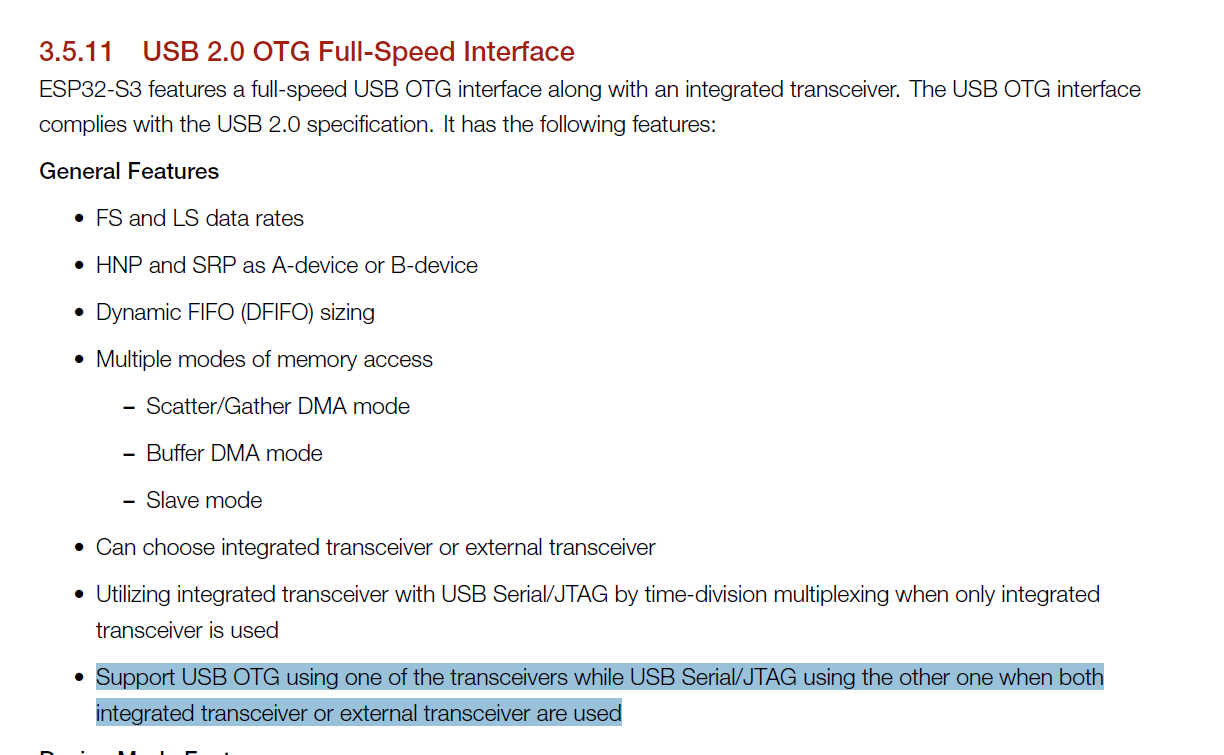
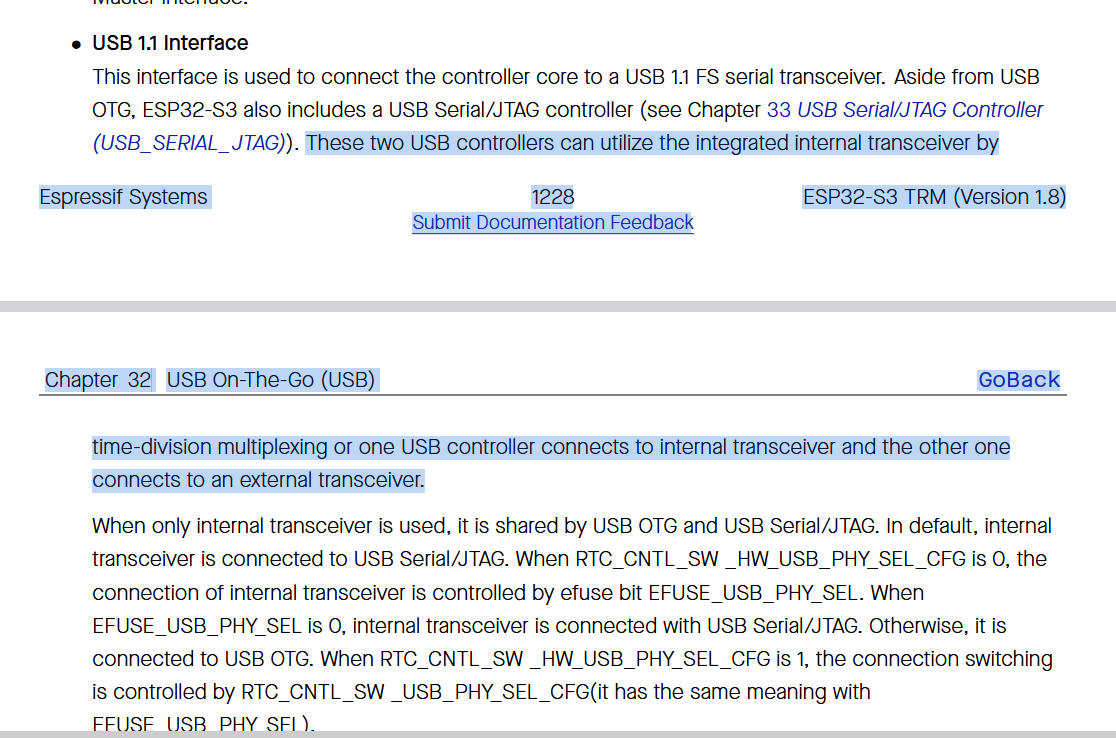
Interesting, though I haven’t seen a board with an external USB transceiver though, or software support. In the Arduino IDE, it’s an either-or decision to use the USB OTG with TinyUSB or the USB JTAG/CDC one.
Edit: Oh it can also have time-division multiplexing on the same internal transceiver.. Interesting?
Yes, for such situations I used GPIOS and a mixed signal scope with 16 digital inputs, this works great. Together with combinatorical triggers its fun.
I just want to bring the debugger up in VSC to have it. In AtmelStudio I usd the debugger with some less hardware related projects, works fine. Maybee I can find out how VSC can do something similar.